

Urban Planning

Jana Urban Space works with national, state, and urban local governments to strengthen statutory planning, and planning instruments that guide urban growth and redevelopment in India. Grounded in on-the-ground conditions, our work moves beyond plan-making as an end in itself. We support governments in moving from fragmented growth to coordinated, place-based development and in addressing structural gaps in India’s planning paradigm, particularly the weak links between plan preparation, implementation, and enforcement. 

Our work includes the preparation of master plans and Neighbourhood Improvement Plans (NIPs), creation of GIS-based spatial databases, and development of planning and regulatory instruments such as building bye-laws and form-based codes. Together, these tools help cities shape land use, guide infrastructure planning, and manage neighbourhood growth and change over time. 

JUSP’s approach balances strategic city growth with physical design. We work with governments to develop planning frameworks that are flexible yet structured, moving away from rigid, top-down plans while avoiding unregulated, ad hoc development. At the core is an integrated strategic framework guided by four principles of 4Es: Economy, Equity, Environment, and Engagement, ensuring planning decisions protect ecological systems, support livelihoods and economic activity, enable fair access to land, housing, infrastructure, and public spaces, and institutionalize citizen engagement in shaping cities.  
Through our urban planning work, we aim to:

  • Strengthen statutory spatial planning across regional, city, and neighborhood scales through robust planning instruments such as development control regulations, building bye-laws, and form-based codes, and stronger governance of planning.  
  • Translate long-term city visions into implementable plans, bridging the gap between plan preparation, projects, budgets, and delivery mechanisms. 
  • Enable coordinated, place-based development by integrating land use, mobility, ecology, infrastructure, and governance through a 4E lens. 
  • Support equitable and climate-resilient urban growth, guiding density, redevelopment, Transit Oriented Development (TOD), and infrastructure investment to protect ecological systems and expand access to opportunities. 
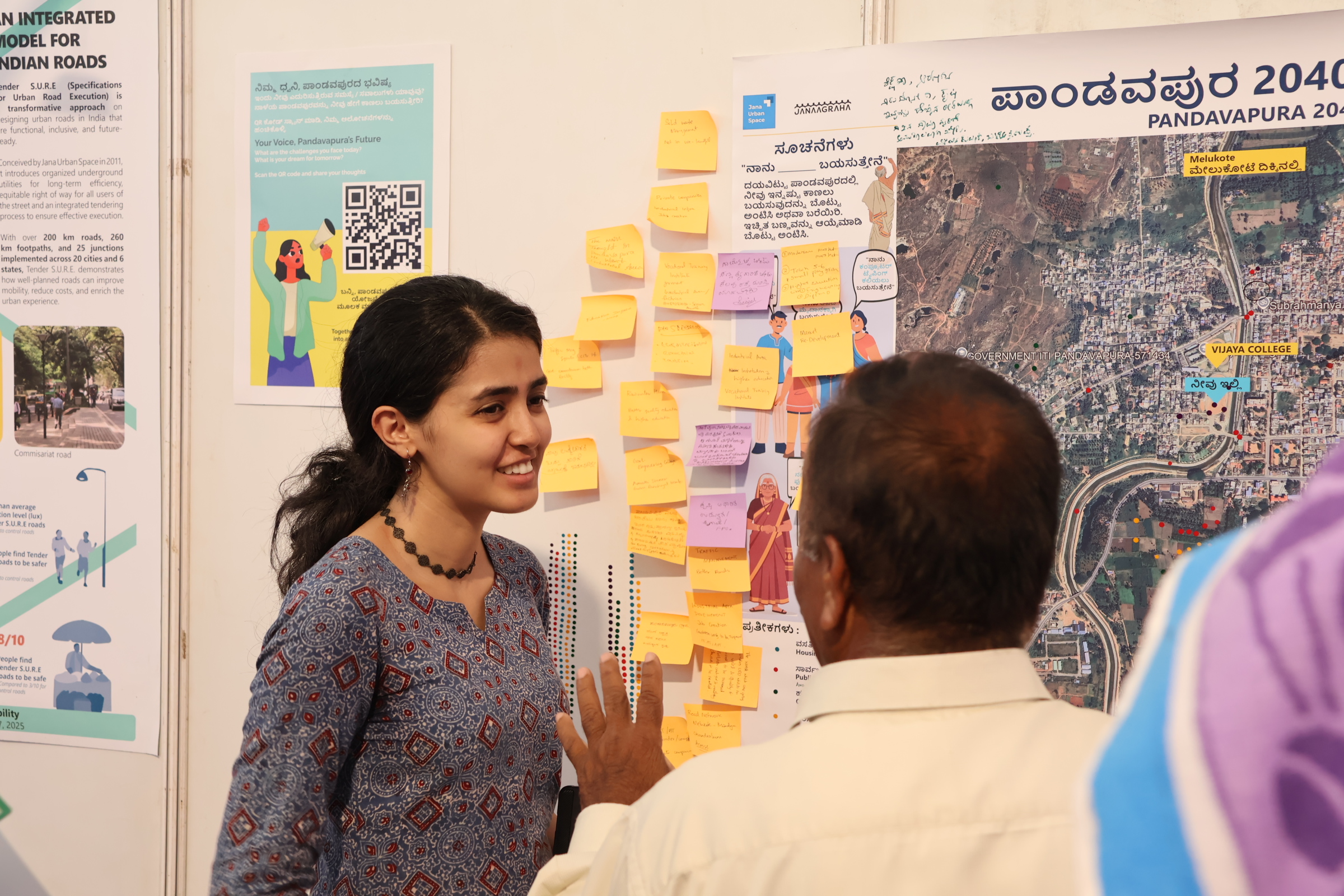
  • Institutionalize citizen engagement in city-making, strengthening participatory planning processes, accountability, and transparency in decision-making. 

Key Urban Planning Domains

Shaping statutory spatial plans

We support the preparation of statutory plans such as master plans, vision plans, and spatial development plans.

Jaipur (Rajasthan) Master Plan 2025 (notified in 2011)

Spatial Development Plans for six towns in Madhya Pradesh (2013)

GIS Databases for four towns in Odisha (2014)

Sawai Madhopur (Rajasthan) Master Plan 2035 (notified in 2017)

Bengaluru Smart City Proposal (approved by MoHUA in 2017)

Neighbourhood Improvement Planning (NIPs)

We position NIPs as the missing link in India’s urban planning system, particularly addressing a critical gap in how plans translate into action.

In India, master plans rarely result in a clear, prioritised list of projects.

As a result, planning remains weakly connected to capital budgets, annual works programmes, and implementation cycles, limiting the ability of cities to deliver visible, high-impact change on the ground.  NIPs directly address this gap by functioning as statutory, spatially anchored neighbourhood-scale plans that convert planning intent into a sequenced pipeline of implementable projects. Each NIP identifies a shelf of neighbourhood-scale interventions across short-, medium-, and long-term horizons (3, 5, and 10 years), with defined spatial boundaries, project typologies, and delivery pathways. 

This approach allows cities to: 

  • Align neighbourhood priorities with capital investment and budgeting processes 
  • Coordinate multiple sectoral investments such as mobility, public spaces, stormwater, housing, and ecology within a single area 
  • Move from standalone projects to programmatic, place-based delivery 

Designed for 3–5-year implementation cycles, NIPs bridge long-term city visions and master plans with short-term, high-impact action, while creating a repeatable model for scaling across cities. Over time, they also generate co-benefits, including improved public health and air quality, safer, more inclusive public spaces, and stronger climate resilience.